What is the JLPT and Why is it Important?
The Japanese Language Proficiency Test (JLPT/日本語能力試験) is an internationally recognized test of Japanese language ability. For Indonesian nationals in Japan, a JLPT certificate is very important for:
- Employment - Most Japanese companies require a minimum of N2 for professional positions.
- Visa - The SSW (Specified Skilled Worker) visa requires a minimum of N4, and immigration points for Permanent Residency (PR) require N1.
- University - Master's/Doctoral programs usually ask for N2 or N1.
- Daily Life - N3 is sufficient to get by, N2 for working comfortably, and N1 for fluency.
Overview of JLPT Levels
| Level | Ability | Kanji | Vocabulary | Study Hours (estimate) |
|---|---|---|---|---|
| N5 | Basic, simple conversation | ~100 | ~800 | 150-300 hours |
| N4 | Basic daily conversation | ~300 | ~1,500 | 300-600 hours |
| N3 | General daily conversation | ~650 | ~3,700 | 450-900 hours |
| N2 | Reading newspapers, working | ~1,000 | ~6,000 | 600-1,200 hours |
| N1 | Reading complex texts, discussions | ~2,000 | ~10,000 | 900-2,400 hours |
Exam Schedule and Registration
- Schedule: Twice a year - July (first week) and December (first week)
- Registration: Around 3-4 months before the exam
- Fee: 7,500 yen in Japan (as of 2026)
- Official Website: jlpt.jp (online registration via MyJLPT)
- Exam locations in Japan: Available in all major prefectures
- Exam locations in Indonesia: Jakarta, Surabaya, Bandung, Medan, and other cities
Exam Structure
N3 (Total: 140 minutes)
| Section | Time | Questions | Passing Score |
|---|---|---|---|
| Language Knowledge (Vocabulary) | 30 minutes | ~35 questions | 19/60 |
| Language Knowledge (Grammar) + Reading (読解) | 70 minutes | ~45 questions | 19/60 |
| Listening (聴解) | 40 minutes | ~30 questions | 19/60 |
Total passing score: 95/180 (and must meet the minimum score in each section)
N2 (Total: 155 minutes)
| Section | Time | Questions | Passing Score |
|---|---|---|---|
| Language Knowledge (Vocabulary + Grammar) + Reading (読解) | 105 minutes | ~75 questions | 19/60 + 19/60 |
| Listening (聴解) | 50 minutes | ~32 questions | 19/60 |
Total passing score: 90/180
N1 (Total: 170 minutes)
| Section | Time | Questions | Passing Score |
|---|---|---|---|
| Language Knowledge + Reading | 110 minutes | ~70 questions | 19/60 + 19/60 |
| Listening | 60 minutes | ~37 questions | 19/60 |
Total passing score: 100/180
Recommended Books per Level
For N3
- Shin Kanzen Master N3 (新完全マスター) - Complete set: Bunpou (Grammar), Dokkai (Reading), Choukai (Listening), Goi (Vocabulary), Kanji. Price: 1,200-1,400 yen each.
- Nihongo So-Matome N3 (日本語総まとめ) - More concise, suitable for self-study. Formatted for 6 weeks per book.
- Try! N3 - A practice question book with detailed explanations.
For N2
- Shin Kanzen Master N2 - The "bible" for N2 preparation. Especially the Bunpou (Grammar) and Dokkai (Reading) books.
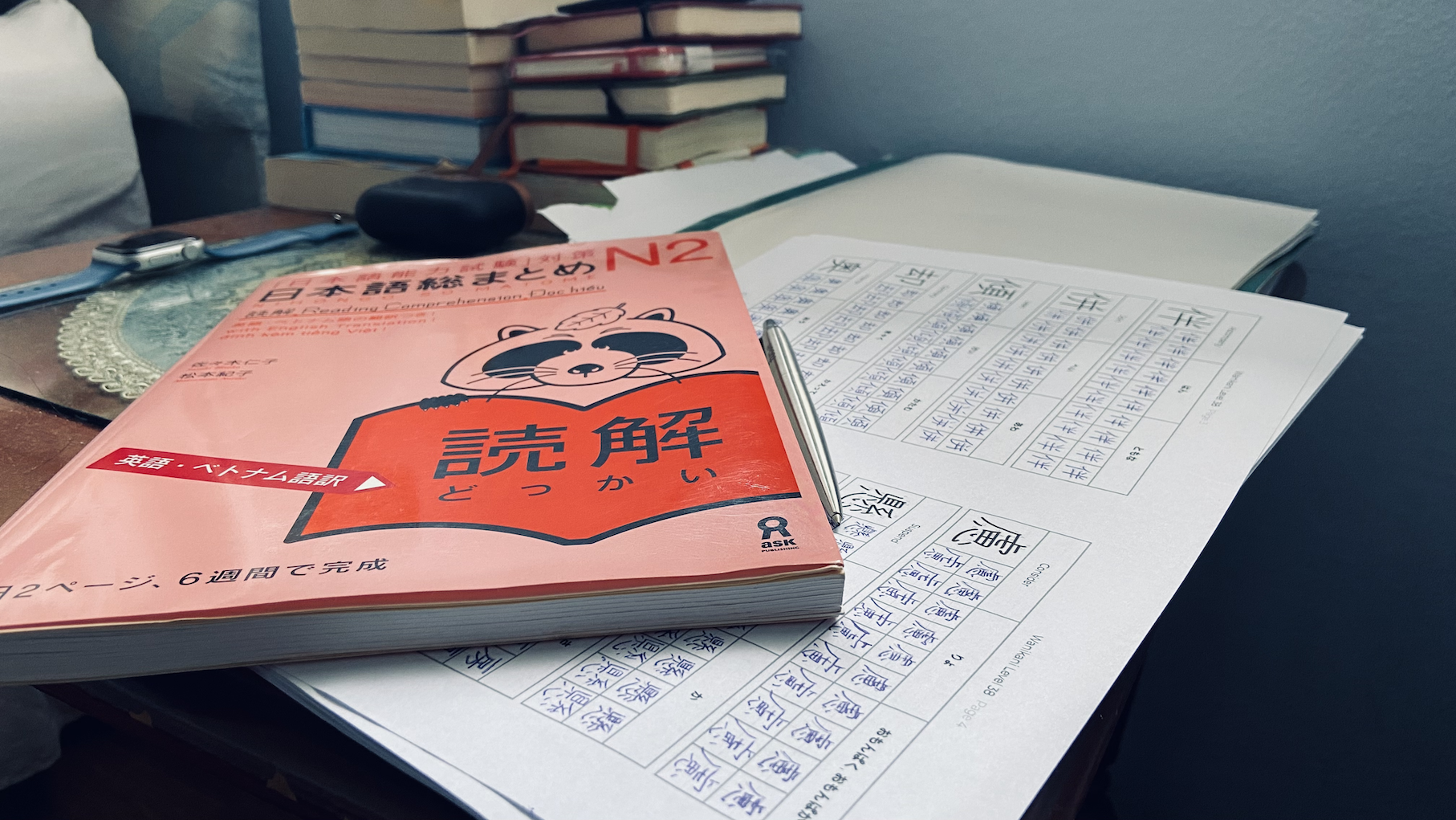
- Nihongo So-Matome N2 - For quick review and memorization.
- Kanzen Master Choukai N2 - The best for listening practice.
For N1
- Shin Kanzen Master N1 - A must-have for all sections.
- Nihongo Noryoku Shiken Taisaku N1 - High-quality practice questions.
- Shin Kanzen Master Dokkai N1 - The key to passing N1 is the ability to read quickly.
6-Month Study Strategy for N2
Here is a study schedule that has proven successful for many Indonesian nationals:
Months 1-2: Foundation
- Review and memorize all N3 grammar points you haven't mastered yet
- Start Shin Kanzen Master Bunpou N2 (5 grammar points/day)
- Memorize 20 new vocabulary words/day using Anki flashcards
- Listening: Listen to Japanese podcasts/YouTube for 30 minutes/day
Months 3-4: Deepening
- Finish Shin Kanzen Master Bunpou N2
- Start Shin Kanzen Master Dokkai N2 (2-3 texts/day)
- Continue memorizing vocabulary (target: 3,000 new words)
- Start doing Choukai practice questions
Months 5-6: Practice and Review
- Work through 4-6 complete sets of past exam papers
- Review all grammar and vocabulary you got wrong
- Focus on your weaknesses (usually Dokkai or Choukai)
- Do a timed mock exam every week
Specific Tips for Indonesians
Advantages for Indonesians
- Many similar loanwords - Some Japanese words are similar to Indonesian due to Portuguese influence (e.g., pan/roti, tempura).
- Sentence structure - Indonesian and Japanese are both agglutinative in some aspects.
- Katakana is easy - Many katakana words from English are also understood by us.
Challenges for Indonesians
- Keigo is difficult - The Indonesian language does not have a system of honorifics as complex as Japan's.
- Particles are confusing - は vs が, に vs で, remain a problem even at the N2 level.
- Kanji - Without a background in Chinese, kanji is the biggest challenge.
Online Applications and Resources
| Resource | Type | Price | Suitable for |
|---|---|---|---|
| Anki | Flashcards (SRS) | Free (PC), 3,500 yen (iOS) | Kanji & vocabulary memorization |
| WaniKani | Kanji learning | $9/month | Kanji from scratch |
| Bunpro | Grammar SRS | $5/month | Grammar N5-N1 |
| NHK News Easy | Reading practice | Free | N3-N2 reading |
| Todai Easy Japanese | News reader app | Free | N3-N1 reading |
| JTest4You | Practice tests | Free | All levels |
Exam Day Tips
- Arrive 30 minutes early - To calm yourself down and get familiar with the room.
- Bring: Exam voucher, ID (Residence Card/passport), 2B pencils and an eraser (not a mechanical pencil), an analog watch (digital ones are sometimes not allowed).
- Dokkai (Reading) time strategy: Don't spend too much time on one question. Skip it and come back if necessary.
- Choukai (Listening) strategy: Read the answer choices BEFORE the audio is played. This gives you context.
- Don't leave answers blank - Guess if you have to; there is no penalty for wrong answers.
After Passing: What's Next?
- Passed N3: Target N2 in the next 1-1.5 years. Start reading manga and light novels.
- Passed N2: You can now apply for jobs at Japanese companies. Start reading newspapers and watching dramas without subtitles.
- Passed N1: Congratulations! This is the highest level. But remember, N1 is not the end. Language is alive and constantly evolving, so keep practicing.
The key to JLPT success is consistency. Studying for 1 hour every day is far more effective than 7 hours once a week. Take advantage of your environment in Japan - listen to conversations on the train, read ads at the station, and practice the language with your colleagues. Ganbatte kudasai!